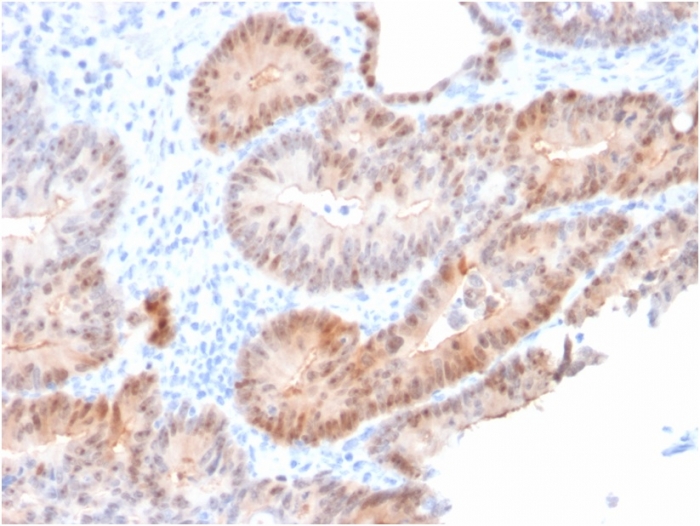
BNUM2255
Aldo-keto Reductase Family 1 Member C2 / DD2(CPTC-AKR1C2-1), 1mg/mL

Eine Lieferung in diese Region ist nicht möglich.
- SKU:
- BNUM2255
- Zusätzliche Namen:
- Aldo-keto Reductase Family 1 Member C2; AKR1C2; 3-alpha-HSD3; AKR1C-pseudo protein; BABP; Dihydrodiol dehydrogenase 2; DD-2; MCDR2; HAKRD; DD; DDH2; HBAB; Pseudo-chlordecone reductase; SRXY8
- Anwendung:
- WB, IHC-P
- Konzentration:
- 1 mg/ml
- Molekulargewicht:
- 37 kDa
- Quelle:
- Animal
- Lagerbedingungen:
- -20[o]C Avoid freeze/thaw cycles.
- Hersteller:
- Biotium
- Host:
- Mouse
- Reaktivitäten:
- Human, Mouse
- Buffer:
- PBS, no BSA, no azide|PBS, no BSA, no sodium azide
- Immunogen:
- Recombinant human full-length AKR1C2 protein
- Formulierung:
- PBS, no BSA, no azide
- Klon:
- CPTC-AKR1C2-1
- Uniprot:
- P52895
- Synonyme:
- 3-alpha-HSD3;AKR1C-pseudo;aldo-keto reductase family 1 member C2;BABP;chlordecone reductase homolog HAKRD;DD;DD-2;DD/BABP;DD2;DDH2;Dihydrodiol dehydrogenase 2;dihydrodiol dehydrogenase 2; bile acid binding protein; 3-alpha hydroxysteroid dehydrogenase, type III;Dihydrodiol dehydrogenase/bile acid-binding protein;HAKRD;HBAB;MCDR2;pseudo-chlordecone reductase;SRXY8;TDD;testicular 17,20-desmolase deficiency;trans-1,2-dihydrobenzene-1,2-diol dehydrogenase;type II dihydrodiol dehydrogenase;Type III 3-alpha-hydroxysteroid dehydrogenase
- Weitere Details:
- Aldo-keto Reductase Family 1 Member C2 (AKR1C2), also known as Dihydrodiol Dehydrogenase 2 (DDH2), is a member of the aldo/keto reductase superfamily, which consists of more than 40 known enzymes and proteins. These enzymes catalyze the conversion of aldehydes and ketones to their corresponding alcohols by utilizing NADH and/or NADPH as cofactors. The enzymes display overlapping but distinct substrate specificity. This enzyme catalyzes the reaction of progesterone to the inactive form 20-alpha-hydroxy-progesterone. Primary antibodies are available purified, or with a selection of fluorescent CF® Dyes and other labels. CF® Dyes offer exceptional brightness and photostability. Note: Conjugates of blue fluorescent dyes like CF®405S and CF®405M are not recommended for detecting low abundance targets, because blue dyes have lower fluorescence and can give higher non-specific background than other dye colors.
- Versandbedingungen:
- Ambient