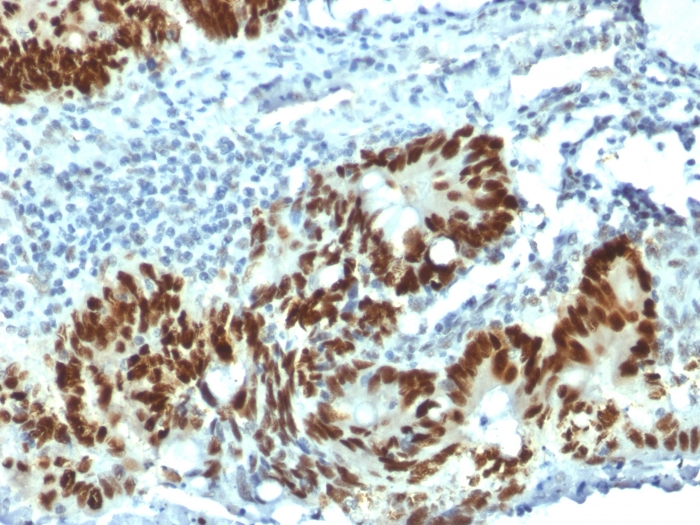
BNUM1916
p53 Tumor Suppressor Protein(PAb1801), 1mg/mL

Eine Lieferung in diese Region ist nicht möglich.
- SKU:
- BNUM1916
- Zusätzliche Namen:
- Antigen NY-CO-13; BCC7; Cellular Tumor Antigen p53; LFS1; TP53; Transformation Related Protein 53 (TRP53); Tumor Protein p53; Tumor Suppressor p53
- Anwendung:
- IHC-P
- Konzentration:
- 1 mg/ml
- Molekulargewicht:
- 53 kDa
- Quelle:
- Animal
- Lagerbedingungen:
- -20[o]C Avoid freeze/thaw cycles.
- Hersteller:
- Biotium
- Host:
- Mouse
- Reaktivitäten:
- Human, Mouse
- Buffer:
- PBS, no BSA, no azide|PBS, no BSA, no sodium azide
- Immunogen:
- Human p53-galactosidase fusion protein
- Formulierung:
- PBS, no BSA, no azide
- Klon:
- PAb1801
- Uniprot:
- P04637
- Synonyme:
- antigen NY-CO-13;BCC7;BMFS5;cellular tumor antigen p53;LFS1;mutant tumor protein 53;P53;p53 tumor suppressor;phosphoprotein p53;transformation-related protein 53;TRP53;tumor protein 53;Tumor suppressor p53;tumor supressor p53
- Weitere Details:
- The specificity of this monoclonal antibody to its intended target was validated by HuProt™ Array, containing more than 19, 000, full-length human proteins. This MAb reacts with an N-terminal epitope (aa32-79) of both wild type and mutated p53. Mutation and/or allelic loss of p53 is one of the causes of a variety of mesenchymal and epithelial tumors. If it occurs in the germ line, such tumors run in families. In most transformed and tumor cells the concentration of p53 is increased 51000 fold over the minute concentrations (1000 molecules cell) in normal cells, principally due to the increased half-life (4 h) compared to that of the wild-type (20 min). p53 Localizes in the nucleus, but is detectable at the plasma membrane during mitosis and when certain mutations modulate cytoplasmic/nuclear distribution. Mutations arise with an average frequency of 70% but incidence varies from zero in carcinoid lung tumors to 97% in primary melanomas. High concentrations of p53 protein are transiently expressed in human epidermis and superficial dermal fibroblasts following mild ultraviolet irradiation. Positive nuclear staining with p53 antibody has been reported to be a negative prognostic factor in breast carcinoma, lung carcinoma, colorectal, and urothelial carcinoma. Primary antibodies are available purified, or with a selection of fluorescent CF® Dyes and other labels. CF® Dyes offer exceptional brightness and photostability. Note: Conjugates of blue fluorescent dyes like CF®405S and CF®405M are not recommended for detecting low abundance targets, because blue dyes have lower fluorescence and can give higher non-specific background than other dye colors.
- Versandbedingungen:
- Ambient