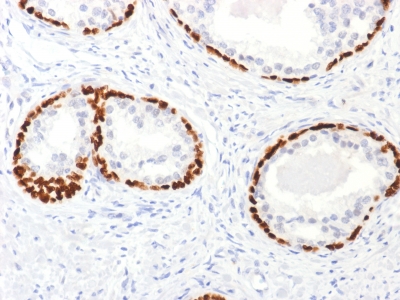
BNUM1684
p63 (Squamous, Basal & Myoepithelial Cell Marker), 1mg/mL

Eine Lieferung in diese Region ist nicht möglich.
- SKU:
- BNUM1684
- Zusätzliche Namen:
- Amplified in squamous cell carcinoma (AIS); Chronic ulcerative stomatitis protein (CUSP); EEC3; Keratinocyte transcription factor KET; LMS; NBP; p40; P51/P63; p53 like transcription factor; p53-related protein p63; RHS; SHFM4; TAp63alpha; TP53CP; TP53L; TP63; TP73; TP73L; Transformation-related protein 63; Trp53rp1; Trp6; 3; Tumor protein 63; Tumor protein p53-like; tumor protein p73-like
- Anwendung:
- IHC-P
- Konzentration:
- 1 mg/ml
- Molekulargewicht:
- 63 kDa
- Quelle:
- Animal
- Lagerbedingungen:
- -20[o]C Avoid freeze/thaw cycles.
- Hersteller:
- Biotium
- Host:
- Rabbit
- Reaktivitäten:
- Human, Rabbit
- Buffer:
- PBS, no BSA, no azide|PBS, no BSA, no sodium azide
- Immunogen:
- Recombinant human p63 protein fragment (exact sequence is proprietary)
- Formulierung:
- PBS, no BSA, no azide
- Uniprot:
- Q9H3D4
- Synonyme:
- AIS;amplified in squamous cell carcinoma;B(p51A);B(p51B);chronic ulcerative stomatitis protein;EEC3;keratinocyte transcription factor KET;KET;LMS;NBP;OFC8;p40;p51;p53CP;p63;p73H;p73L;RHS;SHFM4;TP53CP;TP53L;TP73L;transformation-related protein 63;tumor protein 63;tumor protein p53-competing protein;Tumor protein p73-like
- Weitere Details:
- p63 is a homolog of the tumor suppressor p53. It is identified in basal cells in the epithelial layers of a variety of tissues, including epidermis, cervix, urothelium, breast and prostate. p63 was detected in nuclei of the basal epithelium in normal prostate glands; however, it was not expressed in malignant tumors of the prostate. As a result, p63 has been reported as a useful marker for differentiating benign from malignant lesions in the prostate, particularly when used in combination with markers of high molecular weight cytokeratins and the prostate-specific marker AMACR (P504S). p63 has also been shown to be a sensitive marker for lung squamous cell carcinomas (SqCC), with a sensitivity of ~90%. Specificity for lung SqCC, vs. lung adenocarcinoma (LADC), is approximately 80%. In breast tissue, p63 has been identified in myoepithelial cells of normal ducts. Primary antibodies are available purified, or with a selection of fluorescent CF® Dyes and other labels. CF® Dyes offer exceptional brightness and photostability. Note: Conjugates of blue fluorescent dyes like CF®405S and CF®405M are not recommended for detecting low abundance targets, because blue dyes have lower fluorescence and can give higher non-specific background than other dye colors.
- Versandbedingungen:
- Ambient