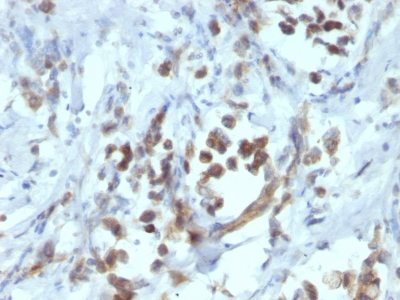
BNUM1166
PAX6(PAX6/1166), 1mg/mL

Eine Lieferung in diese Region ist nicht möglich.
- SKU:
- BNUM1166
- Zusätzliche Namen:
- AN2; Aniridia type II protein; Oculorhombin; Paired box gene 6 (aniridia keratitis); Paired box homeotic gene 6; Paired box protein Pax-6; Sey; WAGR
- Anwendung:
- IHC-P
- Konzentration:
- 1 mg/ml
- Molekulargewicht:
- 47 kDa
- Quelle:
- Animal
- Lagerbedingungen:
- -20[o]C Avoid freeze/thaw cycles.
- Hersteller:
- Biotium
- Host:
- Mouse
- Reaktivitäten:
- Human, Mouse
- Buffer:
- PBS, no BSA, no azide|PBS, no BSA, no sodium azide
- Immunogen:
- Recombinant fragment (N-terminus; aa 1-300) of human PAX6 protein
- Formulierung:
- PBS, no BSA, no azide
- Klon:
- PAX6/1166
- Uniprot:
- P26367
- Synonyme:
- AN;AN1;AN2;Aniridia 1;Aniridia 2;aniridia type II protein;ASGD5;D11S812E;FVH1;MGDA;oculorhombin;paired box homeotic gene-6;paired box protein Pax-6;WAGR
- Weitere Details:
- Pax genes contain paired domains with strong homology to genes in Drosophila, which are involved in programming early development. Lesions in the Pax-6 gene account for most cases of aniridia, a congenital malformation of the eye, chiefly characterized by iris hypoplasia, which can cause blindness. Pax-6 is involved in other anterior segment malformations besides aniridia, such as Peters anomaly, a major error in the embryonic development of the eye with corneal clouding with variable iridolenticulocorneal adhesions. The Pax-6 gene encodes a transcriptional regulator that recognizes target genes through its paired-type DNA-binding domain. The paired domain is composed of two distinct DNA-binding subdomains, the amino-terminal subdomain and the carboxy-terminal subdomain, which bind respective consensus DNA sequences. The human Pax-6 gene produces two alternatively spliced isoforms that have the distinct structure of the paired domain.Primary antibodies are available purified, or with a selection of fluorescent CF® Dyes and other labels. CF® Dyes offer exceptional brightness and photostability. Note: Conjugates of blue fluorescent dyes like CF®405S and CF®405M are not recommended for detecting low abundance targets, because blue dyes have lower fluorescence and can give higher non-specific background than other dye colors.
- Versandbedingungen:
- Ambient