BNUM0532
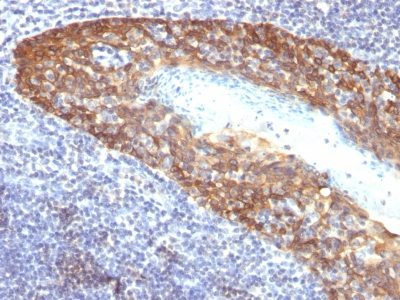
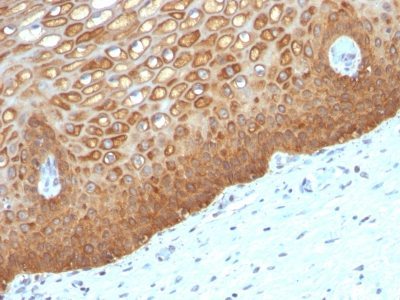
Cytokeratin 14(KRT14/532), 1mg/mL

Eine Lieferung in diese Region ist nicht möglich.
- SKU:
- BNUM0532
- Zusätzliche Namen:
- CK-14; Dowling Meara; ebs3; ebs4; Epidermolysis Bullosa Simplex; k14; Keratin 14; Keratin Type I Cytoskeletal 14; Koebner; krt14; NFJ
- Anwendung:
- IHC-P
- Konzentration:
- 1 mg/ml
- Molekulargewicht:
- ~50 kDa
- Quelle:
- Animal
- Lagerbedingungen:
- -20[o]C Avoid freeze/thaw cycles.
- Hersteller:
- Biotium
- Host:
- Mouse
- Reaktivitäten:
- Human, Mouse, Rat
- Buffer:
- PBS, no BSA, no azide|PBS, no BSA, no sodium azide
- Immunogen:
- Recombinant full-length human KRT14 protein
- Formulierung:
- PBS, no BSA, no azide
- Klon:
- KRT14/532
- Uniprot:
- P02533
- Synonyme:
- CK14;cytokeratin 14;Cytokeratin-14;EBS3;EBS4;K14;keratin 14, type I;Keratin-14;keratin, type I cytoskeletal 14;NFJ
- Weitere Details:
- Cytokeratin 14 (CK14) belongs to the type I (or A or acidic) subfamily of low molecular weight keratins and exists in combination with keratin 5 (type II or B or basic). CK14 is found in basal cells of squamous epithelia, some glandular epithelia, myoepithelium, and mesothelial cells. Anti-CK14 is useful in differentiating squamous cell carcinomas from poorly differentiated epithelial tumors. Anti-CK14 is one of the specific basal markers for distinguishing between basal and non-basal subtypes of breast carcinomas. Anti-CK14 is also a good marker for differentiation of intraductal from invasive salivary duct carcinoma by the positive staining of basal cells surrounding the in-situ neoplasm as well as for differentiation of benign prostate from prostate carcinoma. Furthermore, this antibody has been useful in separating oncocytic tumors of the kidney from its renal mimics, and in identifying metaplastic carcinomas of the breast.Primary antibodies are available purified, or with a selection of fluorescent CF® Dyes and other labels. CF® Dyes offer exceptional brightness and photostability. Note: Conjugates of blue fluorescent dyes like CF®405S and CF®405M are not recommended for detecting low abundance targets, because blue dyes have lower fluorescence and can give higher non-specific background than other dye colors.
- Versandbedingungen:
- Ambient