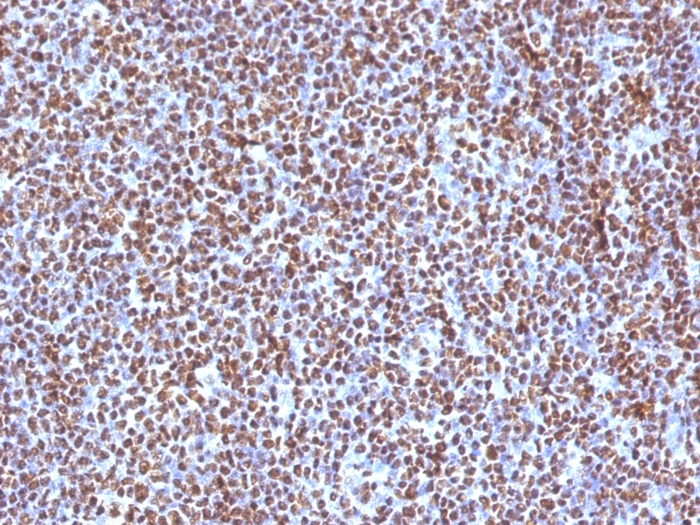
BNUB1504
ALK (Anaplastic Lymphoma Kinase) / CD246(ALK/1504), 0.2mg/mL

Eine Lieferung in diese Region ist nicht möglich.
- SKU:
- BNUB1504
- Zusätzliche Namen:
- ALK Tyrosine Kinase Receptor; Anaplastic Lymphoma Kinase; ALK/NPM1 fusion gene
- Anwendung:
- IHC-P
- Konzentration:
- 0.2 mg/ml
- Molekulargewicht:
- 80 kDa (hybrid); 200 kDa (wild type)
- Quelle:
- Animal
- Lagerbedingungen:
- 2-8[o]C, RT
- Hersteller:
- Biotium
- Host:
- Mouse
- Reaktivitäten:
- Bovine, Human, Mouse
- Buffer:
- PBS, 0.05% BSA, 0.05% azide|PBS, 0.05% BSA, 0.05% sodium azide
- Immunogen:
- Recombinant human ALK protein fragment (aa200-335)
- Formulierung:
- PBS, 0.05% BSA, 0.05% azide
- Klon:
- ALK/1504
- Uniprot:
- Q9UM73
- Synonyme:
- ALK tyrosine kinase receptor;Anaplastic lymphoma kinase;anaplastic lymphoma receptor tyrosine kinase;CD246;CD246 antigen;mutant anaplastic lymphoma kinase;NBLST3
- Weitere Details:
- The wild-type anaplastic lymphoma kinase (ALK) protein is a 200 kDa transmembrane receptor tyrosine kinase. Its expression is restricted to a few scattered cells in the nervous system (some glial cells and neurons, and a few endothelial cells and pericytes). ALK has been found to be rearranged, mutated, or amplified in a series of tumors. The hybrid gene, NPM-ALK, created by the t(2;5)(p23;q35) chromosomal translocation, encodes part of the nucleolar phosphoprotein nucleophosmin (NPM), joined to the entire cytoplasmic portion of ALK. As a consequence, the ALK gene comes under the control of the NPM promoter, which induces a permanent and ubiquitous transcription of the NPM-ALK hybrid gene, resulting in the production of a 80 kDa NPM-ALK chimeric protein. This translocation is found in anaplastic large cell lymphomas (ALCL). Reportedly, expression of ALK indicates a better prognosis. Approximately 5%-10% of non-small cell lung carcinomas also express ALK protein, producing a cytoplasmic staining pattern. This MAb also reacts with blood vessels that serves as an internal positive control. Primary antibodies are available purified, or with a selection of fluorescent CF® Dyes and other labels. CF® Dyes offer exceptional brightness and photostability. Note: Conjugates of blue fluorescent dyes like CF®405S and CF®405M are not recommended for detecting low abundance targets, because blue dyes have lower fluorescence and can give higher non-specific background than other dye colors.
- Versandbedingungen:
- Ambient