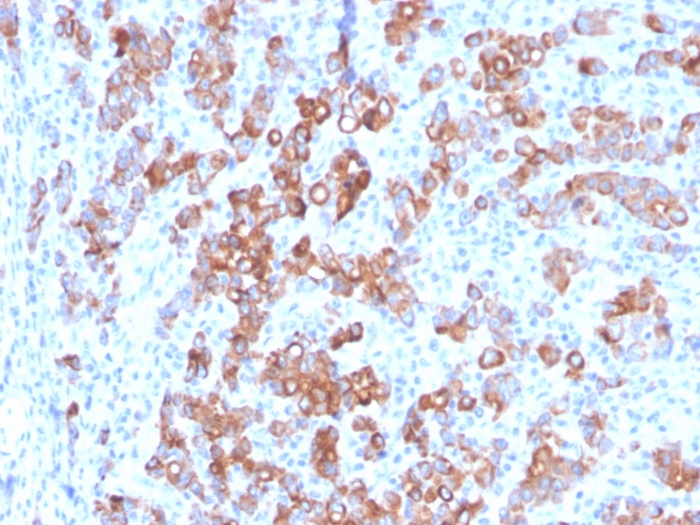
BNCB3113
TIM3 / HAVCR2 / CD366 (Effector T-Cell Marker)(TIM3/3113), Biotin conjugate, 0.1mg/mL

Eine Lieferung in diese Region ist nicht möglich.
- SKU:
- BNCB3113
- Zusätzliche Namen:
- CD366; HAVR2; Hepatitis A virus cellular receptor 2 (HAVCR2); Kidney injury molecule 3 (KIM3); T-cell immunoglobulin and mucin domain-containing protein 3; T-cell immunoglobulin mucin receptor 3; T-cell membrane protein 3; TIM3; TIMD3
- Anwendung:
- IHC-P
- Konzentration:
- 0.1 mg/ml
- Molekulargewicht:
- 60 kda
- Quelle:
- Animal
- Lagerbedingungen:
- 2-8[o]C, RT
- Hersteller:
- Biotium
- Host:
- Mouse
- Reaktivitäten:
- Human
- Buffer:
- 0.05% sodium azide|PBS, 0.1% BSA, 0.05% azide
- Immunogen:
- Recombinant fragment of human TIM3 protein (around aa 22-202) (exact sequence is proprietary)
- Formulierung:
- PBS, 0.1% BSA, 0.05% azide
- Klon:
- TIM3/3113
- Uniprot:
- Q8TDQ0
- Synonyme:
- CD366;HAVcr-2;hepatitis A virus cellular receptor 2;kidney injury molecule-3;KIM-3;SPTCL;T cell immunoglobulin mucin 3;T-cell immunoglobulin and mucin domain-containing protein 3;T-cell immunoglobulin mucin family member 3;T-cell immunoglobulin mucin receptor 3;T-cell membrane protein 3;Tim-3;TIM3;TIMD-3;TIMD3
- Weitere Details:
- TIMs are type I transmembrane glycoproteins with one Ig-like V-type domain and a Ser/Thr-rich mucin stalk. TIM-3 is expressed on the surface of effector T cells (CD4 Th1 and CD8 Tc1) but not on helper T cells (CD4 Th2 and CD8 Tc2). In chronic inflammation, autoimmune disorders, and some cancers, TIM-3 is upregulated on several other hematopoietic cell types. The Ig domain of TIM-3 interacts with a ligand on resting but not activated Th1 and Th2 cells. The glycosylated Ig domain of TIM-3 binds cell-associated galectin-9. This induces TIM-3 Tyr phosphorylation and pro-apoptotic signaling. TIM-3 functions as a negative regulator of Th1 cell activity. Its blockade results in increased IFN-gamma production, Th1 cell proliferation and cytotoxicity, regulatory T cell development, and increases in macrophage and neutrophil infiltration into sites of inflammation. Primary antibodies are available purified, or with a selection of fluorescent CF® Dyes and other labels. CF® Dyes offer exceptional brightness and photostability. Note: Conjugates of blue fluorescent dyes like CF®405S and CF®405M are not recommended for detecting low abundance targets, because blue dyes have lower fluorescence and can give higher non-specific background than other dye colors.
- Versandbedingungen:
- Ambient