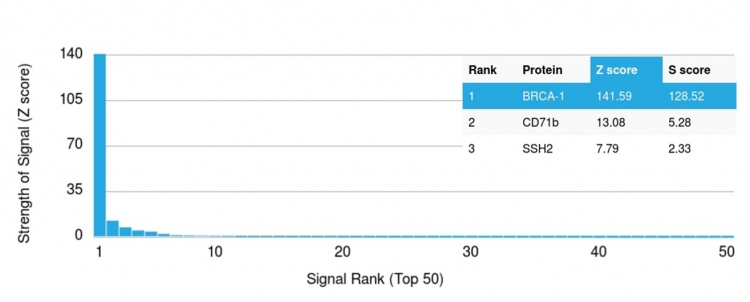
BNCB2985
BRCA1 (Breast Marker)(BRCA1/2985), Biotin conjugate, 0.1mg/mL

Eine Lieferung in diese Region ist nicht möglich.
- SKU:
- BNCB2985
- Zusätzliche Namen:
- BRCA1; Breast and ovarian cancer susceptibility protein 1; Early Onset Breast Cancer 1; Protein phosphatase 1 regulatory subunit 53; RING finger protein 53
- Konzentration:
- 0.1 mg/ml
- Molekulargewicht:
- 220 kDa
- Quelle:
- Animal
- Lagerbedingungen:
- 2-8[o]C, RT
- Hersteller:
- Biotium
- Host:
- Mouse
- Reaktivitäten:
- Bovine, Human, Mouse
- Buffer:
- 0.05% sodium azide|PBS, 0.1% BSA, 0.05% azide
- Immunogen:
- Recombinant fragment (around aa 445-620) of human BRCA1 protein (exact sequence is proprietary)
- Formulierung:
- PBS, 0.1% BSA, 0.05% azide
- Klon:
- BRCA1/2985
- Uniprot:
- P38398
- Synonyme:
- BRCA1/BRCA2-containing complex, subunit 1;BRCAI;BRCC1;breast and ovarian cancer susceptibility protein 1;breast cancer 1, early onset;breast cancer type 1 susceptibility protein;BROVCA1;early onset breast cancer 1;Fanconi anemia, complementation group S;FANCS;IRIS;PNCA4;PPP1R53;protein phosphatase 1, regulatory subunit 53;PSCP;RING finger protein 53;RING-type E3 ubiquitin transferase BRCA1;RNF53
- Weitere Details:
- BRCA1 is a nuclear phosphoprotein that plays a role in maintaining genomic stability, and it also acts as a tumor suppressor. It combines with other tumor suppressors, DNA damage sensors, and signal transducers to form a large multi-subunit protein complex known as the BRCA1-associated genome surveillance complex (BASC). BRCA1 associates with RNA polymerase II, and through the C-terminal domain, also interacts with histone deacetylase complexes. This protein thus plays a role in transcription, DNA repair of double-stranded breaks, and recombination. Mutations in this gene are responsible for approximately 40% of inherited breast cancers and more than 80% of inherited breast and ovarian cancers. Primary antibodies are available purified, or with a selection of fluorescent CF® Dyes and other labels. CF® Dyes offer exceptional brightness and photostability. Note: Conjugates of blue fluorescent dyes like CF®405S and CF®405M are not recommended for detecting low abundance targets, because blue dyes have lower fluorescence and can give higher non-specific background than other dye colors.
- Versandbedingungen:
- Ambient