BNCB2268
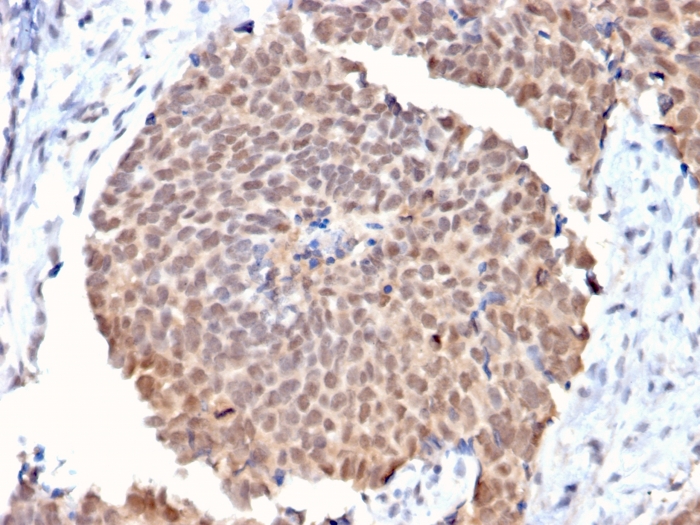
Fas (TNFRSF6) associated factor 1(CPTC-FAF1-2), Biotin conjugate, 0.1mg/mL

Eine Lieferung in diese Region ist nicht möglich.
- SKU:
- BNCB2268
- Zusätzliche Namen:
- CGI-03; FAS-associated factor 1; HFAF1s; UBX domain-containing protein 12; UBX domain-containing protein 3A
- Anwendung:
- WB, IHC-P
- Konzentration:
- 0.1 mg/ml
- Molekulargewicht:
- 75-80 kDa
- Quelle:
- Animal
- Lagerbedingungen:
- 2-8[o]C, RT
- Hersteller:
- Biotium
- Host:
- Mouse
- Reaktivitäten:
- Bovine, Human, Mouse
- Buffer:
- 0.05% sodium azide|PBS, 0.1% BSA, 0.05% azide
- Immunogen:
- Recombinant human full-length FAF1 protein
- Formulierung:
- PBS, 0.1% BSA, 0.05% azide
- Klon:
- CPTC-FAF1-2
- Uniprot:
- Q9UNN5
- Synonyme:
- CGI-03;Fas (TNFRSF6) associated factor 1;FAS-associated factor 1;hFAF1;HFAF1s;TNFRSF6-associated factor 1;UBX domain protein 3A;UBX domain-containing protein 12;UBX domain-containing protein 3A;UBXD12;UBXN3A
- Weitere Details:
- In contrast to growth factors which promote cell proliferation, FAS ligand (FAS-L) and the tumor necrosis factors (TNFs) rapidly induce apoptosis. Cellular response to FAS-L and TNF is mediated by structurally related receptors containing a conserved 'death domain' and belonging to the TNF receptor superfamily. TRADD, FADD and RIP are FAS/TNF-RI interacting proteins that contain a death domain homologous region (DDH). TRADD (TNF-RI-associated death domain) and FADD (FAS-associated death domain) associate with the death domains of both FAS and TNF-RI via their DDH regions, while RIP associates exclusively with FAS. An additional FAS interacting protein designated FAF1, for FAS-associated protein factor-1, binds with the cytoplasmic tail of wildtype but not LPR mutant FAS. When overexpressed in cells, FAF1 enhances the efficiency of FAS-mediated apoptosis. In contrast to TRADD, FADD and RIP, FAF1 lacks a DDH and cannot induce apoptosis independently of FAS activation. Primary antibodies are available purified, or with a selection of fluorescent CF® Dyes and other labels. CF® Dyes offer exceptional brightness and photostability. Note: Conjugates of blue fluorescent dyes like CF®405S and CF®405M are not recommended for detecting low abundance targets, because blue dyes have lower fluorescence and can give higher non-specific background than other dye colors.
- Versandbedingungen:
- Ambient