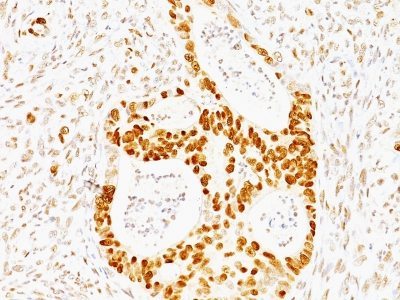
BNCB0817
p53(TRP/817), Biotin conjugate, 0.1mg/mL

Eine Lieferung in diese Region ist nicht möglich.
- SKU:
- BNCB0817
- Zusätzliche Namen:
- Antigen NY-CO-13, BCC7, Cellular Tumor Antigen p53, LFS1, TP53, Transformation Related Protein 53 (TRP53), Tumor Protein p53, Tumor Suppressor p53
- Anwendung:
- WB, IHC-P
- Konzentration:
- 0.1 mg/ml
- Molekulargewicht:
- 53 kDa
- Quelle:
- Animal
- Lagerbedingungen:
- 2-8[o]C, RT
- Hersteller:
- Biotium
- Host:
- Mouse
- Reaktivitäten:
- Bovine, Human, Mouse
- Buffer:
- 0.05% sodium azide|PBS, 0.1% BSA, 0.05% azide
- Immunogen:
- Recombinant human TP53 protein
- Formulierung:
- PBS, 0.1% BSA, 0.05% azide
- Klon:
- TRP/817
- Uniprot:
- P04637
- Synonyme:
- antigen NY-CO-13;BCC7;BMFS5;cellular tumor antigen p53;LFS1;mutant tumor protein 53;P53;p53 tumor suppressor;phosphoprotein p53;transformation-related protein 53;TRP53;tumor protein 53;Tumor suppressor p53;tumor supressor p53
- Weitere Details:
- Recognizes a 53 kDa protein, which is identified as p53 suppressor gene product. It reacts with the mutant as well as the wild form of p53 protein. p53 is a tumor suppressor gene expressed in a wide variety of tissue types and is involved in regulating cell growth, replication, and apoptosis. It binds to MDM2, SV40 T antigen and human papilloma virus E6 protein. Positive nuclear staining with p53 antibody has been reported to be a negative prognostic factor in breast carcinoma, lung carcinoma, colorectal, and urothelial carcinoma. Anti-p53 positivity has also been used to differentiate uterine serous carcinoma from endometrioid carcinoma as well as to detect intratubular germ cell neoplasia. Mutations involving p53 are found in a wide variety of malignant tumors, including breast, ovarian, bladder, colon, lung, and melanoma.Primary antibodies are available purified, or with a selection of fluorescent CF® Dyes and other labels. CF® Dyes offer exceptional brightness and photostability. Note: Conjugates of blue fluorescent dyes like CF®405S and CF®405M are not recommended for detecting low abundance targets, because blue dyes have lower fluorescence and can give higher non-specific background than other dye colors.
- Versandbedingungen:
- Ambient