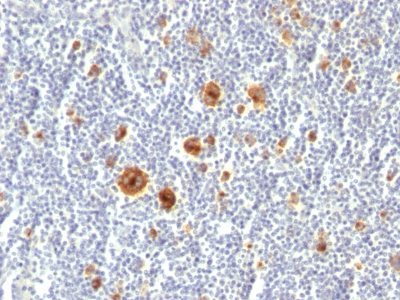
BNC880779
CD30(Ki-1/779), CF488A conjugate, 0.1mg/mL

Eine Lieferung in diese Region ist nicht möglich.
- SKU:
- BNC880779
- Zusätzliche Namen:
- CD30L receptor, Cytokine receptor CD30, Ki-1 antigen, Lymphocyte activation antigen CD30, Tumor necrosis factor receptor superfamily member 8 (TNFRSF8)
- Anwendung:
- IHC-P
- Konzentration:
- 0.1 mg/ml
- Molekulargewicht:
- 105-120 kDa
- Quelle:
- Animal
- Lagerbedingungen:
- 2-8[o]C, RT
- Hersteller:
- Biotium
- Host:
- Mouse
- Reaktivitäten:
- Bovine, Human, Mouse
- Buffer:
- 0.05% sodium azide|PBS, 0.1% BSA, 0.05% azide
- Immunogen:
- Recombinant human TNFRSF8 protein
- Formulierung:
- PBS, 0.1% BSA, 0.05% azide
- Klon:
- Ki-1/779
- Uniprot:
- P28908
- Synonyme:
- AILJK;alpha coat protein;alpha-COP;CD30;CD30L receptor;coatomer protein complex subunit alpha;coatomer subunit alpha;cytokine receptor CD30;D1S166E;HEP-COP;Ki-1;Ki-1 antigen;lymphocyte activation antigen CD30;proxenin;tumor necrosis factor receptor superfamily member 8;xenin
- Weitere Details:
- Recognizes a single chain glycoprotein of 105/120 kDa, identified as CD30/Ki-1. CD30 is synthesized as a 90 kDa precursor, which is processed in the Golgi complex into a membrane-bound phosphorylated mature 105/120 kDa glycoprotein. In Hodgkin's disease, CD30/Ki-1 antigen is expressed by mononuclear-Hodgkin and multinucleated Reed-Sternberg cells. It is also expressed by the tumor cells of a majority of anaplastic large cell lymphomas as well as by a varying proportion of activated T and B cells. This MAb distinguishes large cell lymphomas derived from activated lymphoid cells from histiocytic malignancies and lymphomas derived from resting and precursor lymphoid cells or from anaplastic carcinomas. About one third of the Ki-1 positive lymphomas lack the leukocyte common antigen (CD45). Primary antibodies are available purified, or with a selection of fluorescent CF® Dyes and other labels. CF® Dyes offer exceptional brightness and photostability. Note: Conjugates of blue fluorescent dyes like CF®405S and CF®405M are not recommended for detecting low abundance targets, because blue dyes have lower fluorescence and can give higher non-specific background than other dye colors.
- Versandbedingungen:
- Ambient