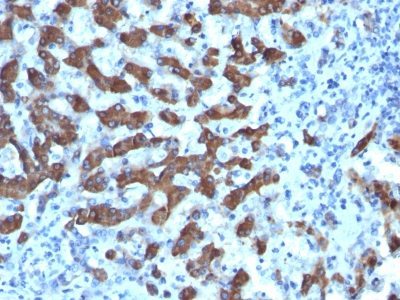
BNC741022
Hepatocyte Specific(CPS1/1022), CF740 conjugate, 0.1mg/mL

Eine Lieferung in diese Region ist nicht möglich.
- SKU:
- BNC741022
- Zusätzliche Namen:
- Carbamoyl-phosphate synthetase 1 (CPS1); Carbamoylphosphate synthetase 1; CPSase 1; CPSASE1
- Anwendung:
- IHC-P
- Konzentration:
- 0.1 mg/ml
- Molekulargewicht:
- ~165 kDa
- Quelle:
- Animal
- Lagerbedingungen:
- 2-8[o]C, RT
- Hersteller:
- Biotium
- Host:
- Mouse
- Reaktivitäten:
- Bovine, Canine, Human, Mouse
- Buffer:
- 0.05% sodium azide|PBS, 0.1% rBSA, 0.05% azide
- Immunogen:
- Recombinant human CPS1 protein
- Formulierung:
- PBS, 0.1% rBSA, 0.05% azide
- Klon:
- CPS1/1022
- Uniprot:
- P31327
- Synonyme:
- carbamoyl-phosphate synthase (ammonia);carbamoyl-phosphate synthase [ammonia], mitochondrial;carbamoyl-phosphate synthase 1, mitochondrial;Carbamoyl-phosphate synthetase I;carbamoylphosphate synthetase I;CPSASE1;GATD6;PHN
- Weitere Details:
- This MAb recognizes a protein of 165 kDa, identified as carbamoyl phosphate synthetase 1 (CPS1). This mitochondrial enzyme catalyzes synthesis of carbamoyl phosphate from ammonia and bicarbonate. This reaction is the first committed step of the urea cycle, which is important in the removal of excess urea from cells.Deficiency of CPS1 is an autosomal recessive disorder that causes hyperammonemia. CPS1 is a hepatocyte specific protein that localizes to the mitochondria of hepatocytes. It is a sensitive marker for distinguishing hepatocellular carcinomas (HCC) from other metastatic carcinomas as well as cholangio-carcinomas. HCC s occur primarily in the stomach, but they are also found in many other organs. CPS1 may also be a useful marker for intestinal metaplasia. Reportedly, strong expression of CPS1 correlates with smaller tumor size and longer patient survival. Occasionally, CPS1 is also found in gastric carcinomas as well as in a few other non-hepatic tumors. Primary antibodies are available purified, or with a selection of fluorescent CF® Dyes and other labels. CF® Dyes offer exceptional brightness and photostability. Note: Conjugates of blue fluorescent dyes like CF®405S and CF®405M are not recommended for detecting low abundance targets, because blue dyes have lower fluorescence and can give higher non-specific background than other dye colors.
- Versandbedingungen:
- Ambient