
RP03162
Recombinant Human PCLAF Protein

Größe
£574.00
- SKU:
- RP03162
- Zusätzliche Namen:
- PCLAF, KIAA0101, NS5ATP9, PAF
- Molekulargewicht:
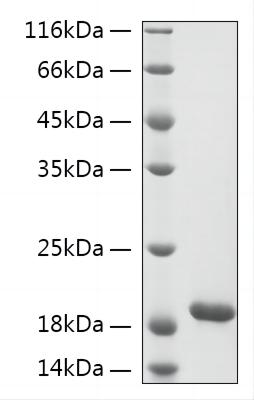
- 19 KDa
- Reinheit:
- ≥95%
- Lagerbedingungen:
- -20[o]C reconstituted. Avoid freeze/thaw cycles., 2-8[o]C reconstituted., -20[o]C/-70[o]C lyophilized. Avoid freeze/thaw cycles.
- Hersteller:
- Abclonal
- Immunogen:
- Met1-Glu111
- Formulierung:
- Recombinant Human PCLAF Protein is produced by HEK293 cells expression system. The target protein is expressed with sequence (Met1-Glu111) of Human PCLAF (Accession #NP_055551.1) fused with a polyhistide tag at the N-terminus.
- Spezies:
- Human
- Sequenz:
- MVRTKADSVPGTYRKVVAARAPRKVLGSSTSATNSTSVSSRKAENKYAGGNPVCVRPTPKWQKGIGEFFRLSPKDSEKENQIPEEAGSSGLGKAKRKACPLQPDHTNDEKE
- Uniprot:
- Q15004
- Synonyme:
- HCV NS5A-transactivated protein 9;hepatitis C virus NS5A-transactivated protein 9;KIAA0101;L5;NS5ATP9;OEATC;OEATC-1;OEATC1;overexpressed in anaplastic thyroid carcinoma 1;p15(PAF);p15/PAF;p15PAF;PAF;PAF15;PCNA-associated factor;PCNA-associated factor of 15 kDa;PCNA-clamp-associated factor
- Weitere Details:
- KIAA11, also known as p15(PAF), is a proliferating cell nuclear antigen-associated factor that interacts with proliferating cell nuclear antigen(PCNA). It was initially isolated in a yeast two-hybrid screen for PCNA binding partners and was shown to bind PCNA competitively with the cell cycle regulator p21(WAF). KIAA11 is localized primarily in the nucleus. It shares the conserved PCNA binding motif with several other PCNA binding proteins including CDK inhibitor p21. KIAA11 is involved in cell proliferation and plays a role in early tumor recurrence (ETR), and prognosis of hepatocellular carcinoma (HCC). KIAA11 is expressed predominantly in the liver, pancreas, and placenta. It cannot be detected in the heart or brain. It is highly expressed in some tumors, especially esophageal tumors, in anaplastic thyroid carcinomas, and non-small-cell lung cancer lines. Overexpression of KIAA11 predicts high stage, early tumor recurrence, and poor prognosis of hepatocellular carcinoma. It also may be involved in the protection of cells from UV-induced cell death.
- Versandbedingungen:
- Blue Ice