

RP01418
Recombinant Human BMPR-2 Protein

Größe
£127.00
- SKU:
- RP01418
- Zusätzliche Namen:
- BMPR2, BMPR-II, BMPR3, BMR2, BRK-3, POVD1, PPH1, T-ALK, bone morphogenetic protein receptor type-2,BMPR-II,BMPR3,BMR2,BRK-3,POVD1,PPH1,T-ALK
- Molekulargewicht:
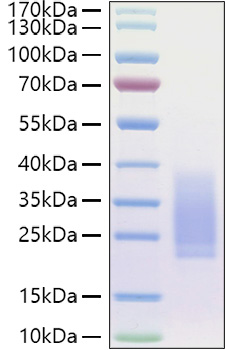
- 20-38 kDa
- Reinheit:
- ≥95%
- Lagerbedingungen:
- -20[o]C reconstituted. Avoid freeze/thaw cycles., 2-8[o]C reconstituted., -20[o]C/-70[o]C lyophilized. Avoid freeze/thaw cycles.
- Hersteller:
- Abclonal
- Immunogen:
- Ser27-Ile151
- Formulierung:
- Recombinant Human BMPR-2 Protein is produced by HEK293 cells expression system. The target protein is expressed with sequence (Ser27-Ile151) of human BMPR2 (Accession #NP_001195.2) fused with a 6xHis tag at the C-terminus.
- Spezies:
- Human
- Sequenz:
- SQNQERLCAFKDPYQQDLGIGESRISHENGTILCSKGSTCYGLWEKSKGDINLVKQGCWSHIGDPQECHYEECVVTTTPPSIQNGTYRFCCCSTDLCNVNFTENFPPPDTTPLSPPHSFNRDETI
- Uniprot:
- Q13873-1
- Synonyme:
- BMP type II receptor;BMP type-2 receptor;BMPR-II;BMPR3;BMR2;bone morphogenetic protein receptor type II;bone morphogenetic protein receptor type-2;bone morphogenetic protein receptor, type II (serine/threonine kinase);BRK-3;POVD1;PPH1;T-ALK;type II activin receptor-like kinase;type II receptor for bone morphogenetic protein-4
- Weitere Details:
- The bone morphogenetic protein type II receptor (BMPR-II, or BMPR2), a receptor for the transforming growth factor (TGF)-beta/bone morphogenetic protein (BMP) superfamily. Reduced expression or function of BMPR2 signaling leads to exaggerated TGF-beta signaling and altered cellular responses to TGF-beta. In endothelial cells, BMPR2 mutation increases the susceptibility of cells to apoptosis. BMPR2 transduces BMP signals by forming heteromeric complexes with and phosphorylating BMP type I receptors. The intracellular domain of BMPR2 is both necessary and sufficient for receptor complex interaction. It had been identified that BMPR2 plays a key role in cell growth. Its mutations lead to hereditary pulmonary hypertension, and knockout of Bmpr-II results in early embryonic lethality. The C-terminal tail of BMPR2 provides binding sites for a number of regulatory proteins that may initiate Smad-independent signalling. BMPR2 mutations were predicted to alter the BMP and TGF-b1/SMAD signalling pathways, resulting in proliferation rather than apoptosis of vascular cells, and greatly increase the risk of developing severe pulmonary arterial hypertension. BMPR2 gene result in familial Primary pulmonary hypertension (PPH) transmitted as an autosomal dominant trait, albeit with low penetrance. Heterozygous germline mutations of BMPR2 gene have been identified in patients with familial and sporadic PPH, indicating that BMPR2 may contribute to the maintenance of normal pulmonary vascular structure and function. Tctex-1, a light chain of the motor complex dynein, interacts with the cytoplasmic domain of BMPR2 and demonstrate that Tctex-1 is phosphorylated by BMPR-II, a function disrupted by PPH disease causing mutations within exon 12. BMPR2 and Tctex-1 co-localize to endothelium and smooth muscle within the media of pulmonary arterioles, key sites of vascular remodelling in PPH.
- Versandbedingungen:
- Blue Ice