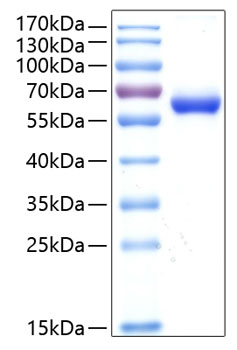

RP00238
Recombinant Human HCVADR/CXADR Protein

Größe
£127.00
- SKU:
- RP00238
- Zusätzliche Namen:
- CXADR,CAR,CAR4/6,HCAR
- Molekulargewicht:
- 60-65 kDa
- Reinheit:
- ≥95%
- Lagerbedingungen:
- -20[o]C reconstituted. Avoid freeze/thaw cycles., 2-8[o]C reconstituted., -20[o]C/-70[o]C lyophilized. Avoid freeze/thaw cycles.
- Hersteller:
- Abclonal
- Immunogen:
- Leu20-Gly237
- Formulierung:
- Recombinant Human HCVADR/CXADR Protein is produced by HEK293 expression system. The target protein is expressed with sequence (Leu20 - Gly237) of human CXADR/CAR (Accession #NP_001329.1) fused with an Fc, 6xHis tag at the C-terminus.
- Spezies:
- Human
- Sequenz:
- LSITTPEEMIEKAKGETAYLPCKFTLSPEDQGPLDIEWLISPADNQKVDQVIILYSGDKIYDDYYPDLKGRVHFTSNDLKSGDASINVTNLQLSDIGTYQCKVKKAPGVANKKIHLVVLVKPSGARCYVDGSEEIGSDFKIKCEPKEGSLPLQYEWQKLSDSQKMPTSWLAEMTSSVISVKNASSEYSGTYSCTVRNRVGSDQCLLRLNVVPPSNKAG
- Uniprot:
- P78310
- Synonyme:
- 46 kD coxsackievirus and adenovirus receptor (CAR) protein;CAR;CAR4/6;coxsackie virus and adenovirus receptor;coxsackievirus and adenovirus receptor;coxsackievirus B-adenovirus receptor;CVB3-binding protein;HCAR;HCVADR
- Weitere Details:
- CXADR (coxsackie and adenovirus receptor), also known as CAR, is a 46 kDa type I transmembrane glycoprotein that belongs to the CTX family of the Ig superfamily. CXADR has received attention as a receptor that facilitates gene transfer mediated by most adenoviruses. It is also an adhesion molecule within junctional complexes, notably between epithelial cells lining body cavities and within myocardial intercalated discs .It is expressed throughout brain neuroepithelium during development, but mainly in ependymal cells in the adult . The 365 amino acid (aa) human CXADR contains a 19 aa signal sequence, a 218 aa extracellular domain (ECD) with a V-type (D1) and a C2-type (D2) Ig-like domain, a 21 aa transmembrane segment and a 107 aa intracellular domain. D1 is thought to be responsible for homodimer formation in trans within tight junctions. The fiber knob of adenoviruses attaches at a similar site, and evidence suggests that disruption of tight junctions facilitates virus binding. The C-terminus interacts with several cytoplasmic junctional proteins, microtubules and the actin cytoskeleton.
- Versandbedingungen:
- Blue Ice