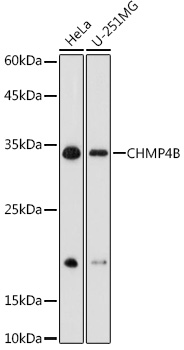
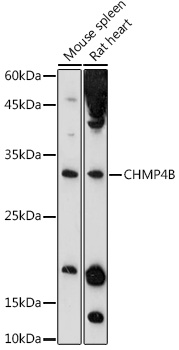


A7402
CHMP4B Rabbit polyclonal antibody

Größe
£152.00
- SKU:
- A7402
- Zusätzliche Namen:
- C20orf178|CHMP4A|CHMP4B|CTPP3|CTRCT31|dJ553F4.4|Shax1|SNF7|SNF7-2|Vps32-2|VPS32B
- Anwendung:
- ELISA, WB, IF, ICC
- Molekulargewicht:
- 25kDa
- Spezies-Reaktivität:
- Human
- Aufreinigung:
- Affinity Purified
- Lagerbedingungen:
- -20[o]C Avoid freeze/thaw cycles.
- Hersteller:
- Abclonal
- Host:
- Rabbit
- Reaktivitäten:
- Human, Mouse, Rat
- Immunogen:
- Recombinant protein (or fragment).This information is considered to be commercially sensitive.
- Formulierung:
- Unmodified
- Sequenz:
- MSVFGKLFGAGGGKAGKGGPTPQEAIQRLRDTEEMLSKKQEFLEKKIEQELTAAKKHGTKNKRAALQALKRKKRYEKQLAQIDGTLSTIEFQREALENANTNTEVLKNMGYAAKAMKAAHDNMDIDKVDELMQDIADQQELAEEISTAISKPVGFGEEFDEDELMAELEELEQEELDKNLLEISGPETVPLPNVPSIALPSKPAKKKEEEDDDMKELENWAGSM
- Uniprot:
- Q9H444
- Synonyme:
- C20orf178;charged multivesicular body protein 4b;CHMP4A;chromatin modifying protein 4B;chromatin-modifying protein 4b;CTPP3;CTRCT31;dJ553F4.4;hSnf7-2;hVps32-2;Shax1;SNF7;SNF7 homolog associated with Alix 1;Snf7 homologue associated with Alix 1;SNF7-2;Vacuolar protein sorting-associated protein 32-2;vacuolar protein-sorting-associated protein 32-2;Vps32-2;VPS32B
- Weitere Details:
- This gene encodes a member of the chromatin-modifying protein/charged multivesicular body protein (CHMP) protein family. The protein is part of the endosomal sorting complex required for transport (ESCRT) complex III (ESCRT-III), which functions in the sorting of endocytosed cell-surface receptors into multivesicular endosomes. The ESCRT machinery also functions in the final abscisson stage of cytokinesis and in the budding of enveloped viruses such as HIV-1. The three proteins of the CHMP4 subfamily interact with programmed cell death 6 interacting protein (PDCD6IP, also known as ALIX), which also functions in the ESCRT pathway. The CHMP4 proteins assemble into membrane-attached 5-nm filaments that form circular scaffolds and promote or stabilize outward budding. These polymers are proposed to help generate the luminal vesicles of multivesicular bodies. Mutations in this gene result in autosomal dominant posterior polar cataracts.
- Versandbedingungen:
- Blue Ice