

A2710
MEF2A+MEF2C Rabbit monoclonal antibody

Größe
Auf Anfrage
- SKU:
- A2710
- Zusätzliche Namen:
- ADCAD1|C5DELq14.3|DEL5q14.3|mef2|MEF2A+MEF2C|NEDHSIL|RSRFC4|RSRFC9
- Anwendung:
- ELISA, WB, IHC-P
- Molekulargewicht:
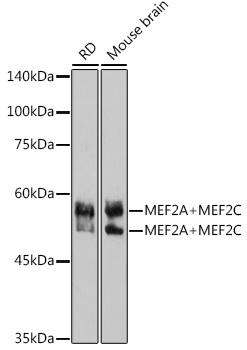
- 51kDa/54kDa
- Spezies-Reaktivität:
- Human
- Aufreinigung:
- Affinity Purified
- Lagerbedingungen:
- -20[o]C Avoid freeze/thaw cycles.
- Hersteller:
- Abclonal
- Host:
- Rabbit
- Reaktivitäten:
- Human, Mouse
- Immunogen:
- Recombinant protein (or fragment).This information is considered to be commercially sensitive.
- Formulierung:
- Unmodified
- Sequenz:
- NRKPDLRVLIPPGSKNTMPSVSEDVDLLLNQRINNSQSAQSLATPVVSVATPTLPGQGMGGYPSAISTTYGTEYSLSSADLSSLSGFNTASALHLGSVTGWQQQHLHNMPPSALSQLGACTSTHLSQSSNLSLPSTQSLNIKSEPVSPPRDRTTTPSRYPQHTRHEAGRSPVDSLSSCSSSYDGSDREDHRNEFHSPIGLTRPSPDERESPSVKRMRLSEGWAT
- Uniprot:
- Q02078, Q06413
- Synonyme:
- ADCAD1;C5DELq14.3;DEL5q14.3;MADS box transcription enhancer factor 2, polypeptide A (myocyte enhancer factor 2A);MADS box transcription enhancer factor 2, polypeptide C;mef2;Myocyte enhancer factor 2C;myocyte-specific enhancer factor 2A;myocyte-specific enhancer factor 2C;NEDHSIL;RSRFC4;RSRFC9;serum response factor-like protein 1
- Weitere Details:
- This locus encodes a member of the MADS box transcription enhancer factor 2 (MEF2) family of proteins, which play a role in myogenesis. The encoded protein, MEF2 polypeptide C, has both trans-activating and DNA binding activities. This protein may play a role in maintaining the differentiated state of muscle cells. Mutations and deletions at this locus have been associated with severe cognitive disability, stereotypic movements, epilepsy, and cerebral malformation. Alternatively spliced transcript variants have been described.The protein encoded by this gene is a DNA-binding transcription factor that activates many muscle-specific, growth factor-induced, and stress-induced genes. The encoded protein can act as a homodimer or as a heterodimer and is involved in several cellular processes, including muscle development, neuronal differentiation, cell growth control, and apoptosis. Defects in this gene could be a cause of autosomal dominant coronary artery disease 1 with myocardial infarction (ADCAD1). Several transcript variants encoding different isoforms have been found for this gene.
- Versandbedingungen:
- Blue Ice