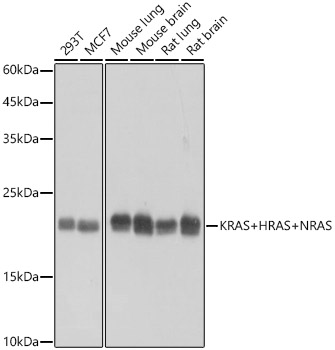
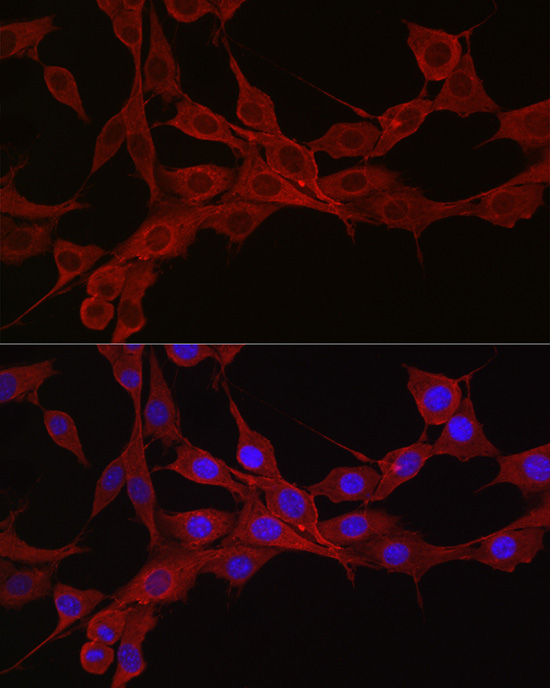
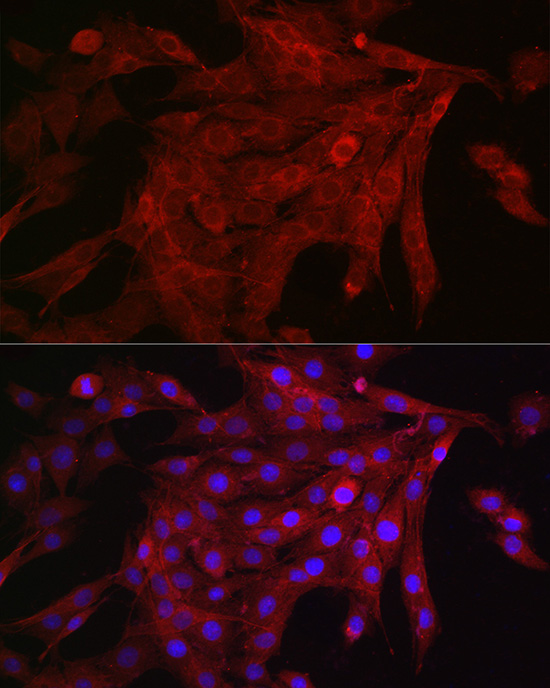
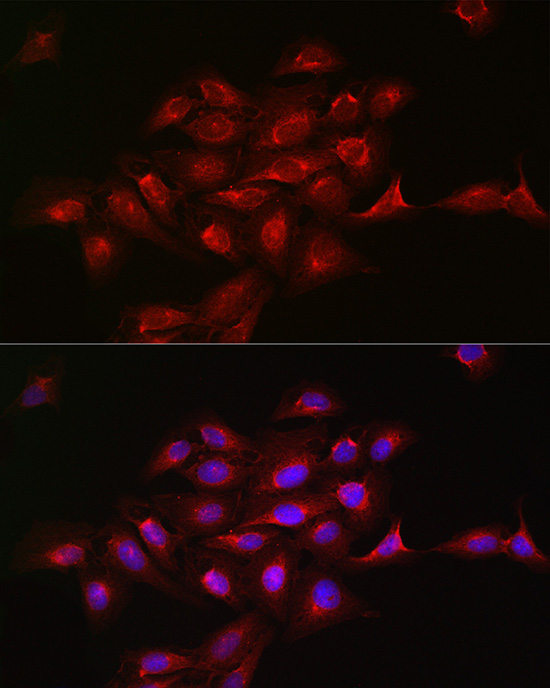
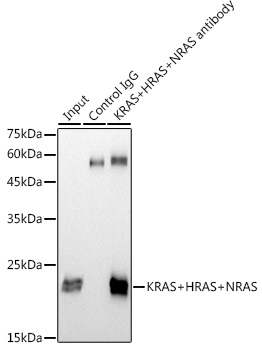


A22438
KRAS+HRAS+NRAS Rabbit monoclonal antibody

Größe
Auf Anfrage
- SKU:
- A22438
- Zusätzliche Namen:
- C-K-RAS|c-Ki-ras2|CFC2|K-RAS2A|K-RAS2B|K-RAS4A|K-RAS4B|KI-RAS|KRAS+HRAS+NRAS|KRAS1|KRAS2|NS|NS3|RALD|RASK2
- Anwendung:
- ELISA, WB, IF, ICC, IP
- Molekulargewicht:
- 21kDa
- Spezies-Reaktivität:
- Human
- Aufreinigung:
- Affinity Purified
- Lagerbedingungen:
- -20[o]C Avoid freeze/thaw cycles.
- Hersteller:
- Abclonal
- Host:
- Rabbit
- Reaktivitäten:
- Human, Mouse, Rat
- Immunogen:
- Synthetic peptide. This information is considered to be commercially sensitive.
- Formulierung:
- Unmodified
- Sequenz:
- MTEYKLVVVGAGGVGKSALTIQLIQNHFVDEYDPTIEDSYRKQVVIDGETCLLDILDTAGQEEYSAMRDQYMRTGEGFLCVFAINNSKSFADINLYREQI
- Uniprot:
- P01111, P01112, P01116
- Synonyme:
- 'C-K-RAS;ALPS4;C-BAS/HAS;C-H-RAS;C-HA-RAS1;c-has/bas p21 protein;C-K-RAS;c-Ki-ras;c-Ki-ras2;c-Kirsten-ras protein;cellular c-Ki-ras2 proto-oncogene;cellular transforming proto-oncogene;CFC2;CMNS;CTLO;GTP- and GDP-binding peptide B;GTPase HRas;GTPase KRas;GTPase NRas;H-Ras-1;H-RASIDX;Ha-Ras;Ha-Ras1 proto-oncoprotein;HAMSV;Harvey rat sarcoma viral oncogene homolog;Harvey rat sarcoma viral oncoprotein;HRAS1;K-Ras;K-Ras 2;K-ras p21 protein;K-RAS2A;K-RAS2B;K-RAS4A;K-RAS4B;KI-RAS;Kirsten rat sarcoma viral oncogene homolog;Kirsten rat sarcoma viral proto-oncogene;KRAS1;KRAS2;N-ras;N-ras protein part 4;NCMS;neuroblastoma RAS viral (v-ras) oncogene homolog;neuroblastoma RAS viral oncogene homolog;NRAS1;NS;NS3;NS6;OES;oncogene KRAS2;p19 H-RasIDX protein;p21ras;PR310 c-K-ras oncogene;RALD;Ras family small GTP binding protein H-Ras;RASH1;RASK2;transformation gene: oncogene HAMSV;transforming protein N-Ras;transforming protein p21;v-Ha-ras Harvey rat sarcoma viral oncogene homolog;v-Ki-ras2 Kirsten rat sarcoma 2 viral oncogene homolog;v-ras neuroblastoma RAS viral oncogene homolog
- Weitere Details:
- This gene, a Kirsten ras oncogene homolog from the mammalian ras gene family, encodes a protein that is a member of the small GTPase superfamily. A single amino acid substitution is responsible for an activating mutation. The transforming protein that results is implicated in various malignancies, including lung adenocarcinoma, mucinous adenoma, ductal carcinoma of the pancreas and colorectal carcinoma. Alternative splicing leads to variants encoding two isoforms that differ in the C-terminal region. [provided by RefSeq, Jul 2008]
- Versandbedingungen:
- Blue Ice