HMGB1 Recombinant Monoclonal Antibody
Produktgrößen
50 ul
£235,00
CSB-RA439052A0HU-50UL
100 ul
£392,00
CSB-RA439052A0HU-100UL
Über dieses Produkt
- SKU:
- CSB-RA439052A0HU
- Zusätzliche Namen:
- High mobility group protein B1 (High mobility group protein 1) (HMG-1), HMGB1, HMG1
- Anwendung:
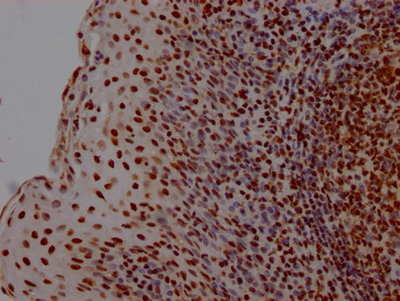
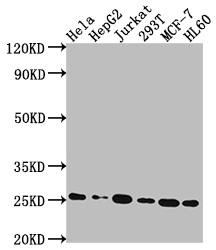
- ELISA, Immunohistochemistry, Western Blot
- Buffer:
- phosphate buffered saline, 150mm nacl
- translate.label.attr.clone:
- 1A1
- Klonalität:
- Recombinant Monoclonal
- Weitere Details:
- Multifunctional redox sensitive protein with various roles in different cellular compartments. In the nucleus is one of the major chromatin-associated non-histone proteins and acts as a DNA chaperone involved in replication, transcription, chromatin remodeling, V(D)J recombination, DNA repair and genome stability. Proposed to be an universal biosensor for nucleic acids. Promotes host inflammatory response to sterile and infectious signals and is involved in the coordination and integration of innate and adaptive immune responses. In the cytoplasm functions as sensor and/or chaperone for immunogenic nucleic acids implicating the activation of TLR9-mediated immune responses, and mediates autophagy. Acts as danger associated molecular pattern (DAMP) molecule that amplifies immune responses during tissue injury (PubMed:27362237). Released to the extracellular environment can bind DNA, nucleosomes, IL-1 beta, CXCL12, AGER isoform 2/sRAGE, lipopolysaccharide (LPS) and lipoteichoic acid (LTA), and activates cells through engagement of multiple surface receptors. In the extracellular compartment fully reduced HMGB1 (released by necrosis) acts as a chemokine, disulfide HMGB1 (actively secreted) as a cytokine, and sulfonyl HMGB1 (released from apoptotic cells) promotes immunological tolerance (PubMed:23519706, PubMed:23446148, PubMed:23994764, PubMed:25048472). Has proangiogdenic activity (By similarity). May be involved in platelet activation (By similarity). Binds to phosphatidylserine and phosphatidylethanolamide (By similarity). Bound to RAGE mediates signaling for neuronal outgrowth (By similarity). May play a role in accumulation of expanded polyglutamine (polyQ) proteins such as huntingtin (HTT) or TBP (PubMed:23303669, PubMed:25549101).
- Immunogen:
- A synthesized peptide derived from human HMGB1
- Isotyp:
- IgG
- Physischer Zustand:
- Liquid
- Aufreinigung:
- Affinity Purified
- Reaktivitäten:
- Human
- Versandbedingungen:
- Blue Ice
- Lagerbedingungen:
- -20[o]C/-70[o]C Avoid freeze/thaw cycles.
- Hersteller:
- Cusabio
- Typ:
- Antibody: Recombinant Antibodies
- Datenblatt des Herstellers:HMGB1-Antibody-12928683.html