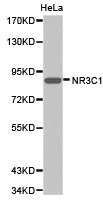
NR3C1 Antibody
Produktgrößen
100 ul
£445,00
CSB-PA016059KA01HU-100UL
Über dieses Produkt
- SKU:
- CSB-PA016059KA01HU
- Zusätzliche Namen:
- GCCR antibody; GCR antibody; GCR_HUMAN antibody; GCRST antibody; glucocorticoid nuclear receptor variant 1 antibody; Glucocorticoid receptor antibody; GR antibody; GRL antibody; Grl1 antibody; nr3c1 antibody; Nuclear receptor subfamily 3 group C member 1 antibody; nuclear receptor subfamily 3, group C, member 1 (glucocorticoid receptor) antibody
- Anwendung:
- ELISA, Immunohistochemistry, Western Blot
- Buffer:
- Store at -20°C or -80°C. Avoid freeze / thaw cycles. Buffer: PBS with 0.02% sodium azide, 50% glycerol, pH7.3.
- Klonalität:
- Polyclonal
- Weitere Details:
- Glucocorticoid hormones control cellular proliferation, inflammation, and metabolism through their association with the glucocorticoid receptor (GR)/NR3C1, a member of the nuclear hormone receptor superfamily of transcription factors. GR is composed of several conserved structural elements, including a carboxy-terminal ligand-binding domain (which also contains residues critical for receptor dimerization and hormone-dependent gene transactivation), a neighboring hinge region containing nuclear localization signals, a central zinc-finger-containing DNA-binding domain, and an amino-terminal variable region that participates in ligand-independent gene transcription. In the absence of hormone, a significant population of GR is localized to the cytoplasm in an inactive form via its association with regulatory chaperone proteins, such as HSP90, HSP70, and FKBP52. On hormone binding, GR is released from the chaperone complex and translocates to the nucleus as a dimer to associate with specific DNA sequences termed glucocorticoid response elements (GREs), thereby enhancing or repressing transcription of specific target genes. It was demonstrated that GR-mediated transcriptional activation is modulated by phosphorylation. Although GR can be basally phosphorylated in the absence of hormone, it becomes hyperphosphorylated upon binding receptor agonists. It has been suggested that hormone-dependent phosphorylation of GR may determine target promoter specificity, cofactor interaction, strength and duration of receptor signaling, receptor stability, and receptor subcellular localization. Indeed Ser211 of human GR is phosphorylated to a greater extent in the presence of hormone, and biochemical fractionation studies following hormone treatment indicate that Ser211-phosphorylated GR is found in the nucleus. Thus, Ser211 phosphorylation is a biomarker for activated GR in vivo. An added layer of complexity to GR signaling lies in the ability of multiple isoforms to be generated through both alternative splicing and the use of alternative translation intiation start sites, thus increasing the repertoire of functional signaling homo- and heterodimers.
- Host:
- Rabbit
- Immunogen:
- Recombinant protein of Human NR3C1
- Isotyp:
- IgG
- Physischer Zustand:
- Liquid
- Aufreinigung:
- Affinity Purified
- Reaktivitäten:
- Human, Mouse, Rat
- Versandbedingungen:
- Blue Ice
- Lagerbedingungen:
- -20[o]C/-70[o]C Avoid freeze/thaw cycles.
- Hersteller:
- Cusabio
- Typ:
- Antibody: Polyclonal Antibody
- Datenblatt des Herstellers:NR3C1-Antibody-158191.html